

How to start courier business: Your UK launch guide

Mar 31
18 min read
Updated: Jun 24
Published: 31 March 2026 | Last Updated: 24 June 2026
Written by: Monica Nascimento, Insurance Expert
Getting a courier business off the ground isn't just one big step; it's a series of smart, calculated moves. You'll need to juggle everything from creating a rock-solid business plan and sorting out the legal red tape to picking the right van and getting insured. It's a process that demands serious market research and a clear strategy if you want to hold your own against the established players.
Crafting Your Courier Business Plan
Before you even dream of buying a van or printing flyers, the most important thing you can invest is your time. You need to build a business plan. This isn't just a document to wave at a bank manager for a loan; it's your roadmap. It will guide every decision you make, from day one right through to scaling up.
This isn't about filling in a generic template. It’s about digging deep into the real-world specifics of your local area. Before you get lost in the details of courier services, it's a good idea to get a grip on the basics of running any business.
Identifying Profitable Niches in Your Area
Your first real task is to find the gaps in the market that the big names like DPD and Royal Mail just can't fill. They’re all about volume, but you can build a thriving business by offering something more specialised. Look around your town or city. What do local businesses really need?
Could you be the go-to courier for things like:
Urgent Medical Deliveries: Shuttling samples between clinics and labs, or getting prescriptions from pharmacies to people who can't leave home. For example, a local dental surgery might need a reliable courier to transport moulds to a dental laboratory on the same day.
Confidential Legal Documents: Becoming the trusted courier for local solicitors and accountants who need secure, hand-delivered paperwork. A law firm might pay a premium for a courier to serve court documents in person, requiring a signature as proof of delivery.
Specialised Artisan Goods: Carefully handling fragile items for local bakers, florists, or craft breweries that need a personal touch. A wedding cake maker, for instance, needs a courier they can trust implicitly to transport a three-tier cake without a single mishap.
Last-Mile for Local Retailers: Partnering with independent shops to offer a same-day delivery service they could never manage on their own. This could involve delivering organic vegetable boxes or high-end fashion items to customers within a 10-mile radius.
The trick is to find a niche where people are willing to pay for reliability and specialist care, not just the cheapest price.
Analysing Local Competitors
Once you've got a few niches in mind, it's time to see who you're up against. I'm not talking about the national giants. I mean the other independent couriers and small local firms fighting for the exact same contracts you want.
A quick Google search for "same-day courier in [your town]" is the perfect place to start. Check out their websites, what they offer, and what customers are saying in their reviews. What are they good at? Even better, where are they falling short? A string of reviews complaining about late deliveries or poor communication is a golden opportunity for you to swoop in and do it better.
This visual guide shows you the flow, from that initial research right through to your financial planning.
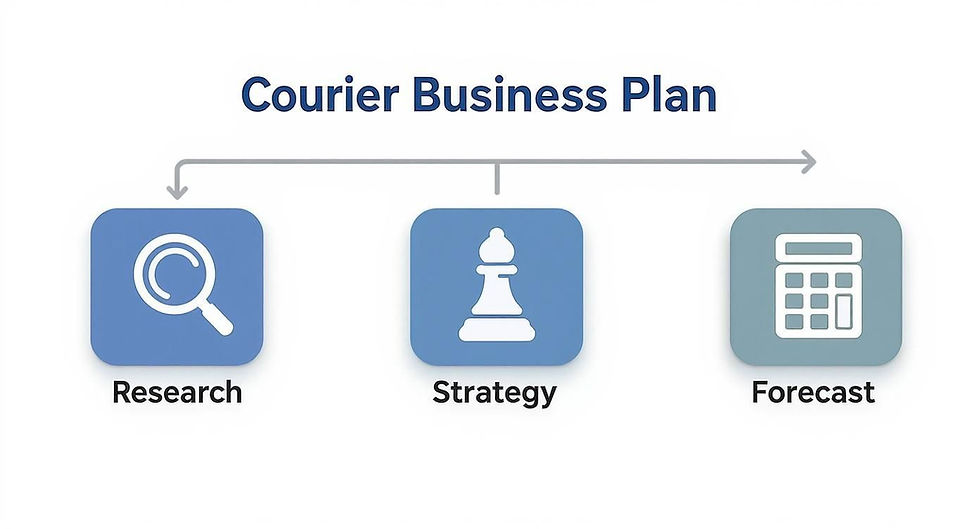
As you can see, solid research is what feeds directly into a winning strategy and realistic financial forecasts.
Core Components of Your Courier Business Plan
A well-structured business plan is your best tool for securing funding and keeping your strategy on track. Below is a breakdown of the must-have sections and the key questions each one should answer.
Section | Key Questions to Answer | Example Focus |
Executive Summary | What is your business? What is your mission? What are your key goals? | "To become the premier same-day medical courier for clinics in Manchester, known for reliability and secure handling." |
Company Description | What is your legal structure? Who are the key people involved? | Sole trader status, highlighting your personal experience in logistics or healthcare. |
Market Analysis | Who are your target customers? What is the market size? Who are your competitors? | Focusing on the growing number of private dental clinics and labs in the North West and their specific needs. |
Services Offered | What specific services will you provide? How are they different from competitors? | Detailing tiered services: 4-hour, 2-hour, and emergency 1-hour delivery for medical samples. |
Marketing & Sales | How will you reach your target market? What is your pricing strategy? | A plan to directly contact clinic managers, combined with targeted local online ads and a simple, transparent pricing model. |
Financial Projections | What are your startup costs? What are your projected revenue and profit for 3 years? | A detailed breakdown of van lease, insurance, fuel, and marketing costs against realistic revenue forecasts. |
Treat this table as your checklist. A plan that answers these questions thoroughly is one that investors—and you—can have confidence in.
Defining Your Unique Selling Proposition
All your research into the market and your competitors should lead you to one thing: your Unique Selling Proposition (USP). This is the simple, powerful reason a client should pick you over everyone else.
"Your USP isn't just what you do; it's how you solve a specific problem for a specific type of customer. For example, instead of just being a "local courier," you become "the only 24/7 courier for emergency legal document delivery in Manchester.""
The UK's courier and postal sector is a massive industry. Revenue is expected to hit £28.5 billion in 2025, with over 33,000 businesses competing for a slice of the pie. That growth shows there's plenty of work to go around, especially for newcomers who know exactly who they are and what they offer. Your USP is what will help you claim your piece of this thriving industry.
Handling Your Legal and Licensing Requirements
Right, let’s talk about the paperwork. Getting your legal house in order is the step that turns your courier idea from a thought into a proper, protected business. Get this right from day one, and you’ll save yourself a world of headaches and potential fines down the line. It's your foundation for growth.

The UK courier market is a competitive space, no doubt about it. The big three—Royal Mail, DHL, and UPS—control over 60% of the action. But that leaves a huge 40% slice of the pie for independent operators like you to grab. This is where you can carve out a niche, serving specific local areas or industries the big boys overlook. A solid legal setup makes you look professional and ready to compete.
Choosing Your Business Structure
Your first big decision is how to structure your business. For most new couriers in the UK, it boils down to two choices: operating as a sole trader or setting up a limited company. Each path has massive implications for your personal liability, how you pay tax, and the amount of admin you'll face.
Setting up as a sole trader is the simplest and fastest way to get going. Legally, you and your business are one and the same. This is great because you keep all the profits after tax, but it also means you are personally on the hook for any business debts.
A limited company (Ltd), on the other hand, is a completely separate legal entity. This is a game-changer because it shields your personal assets—like your house or car—if the business ever gets into financial trouble. The trade-off? More paperwork and stricter reporting rules.
"Key Takeaway: If you're starting small, maybe just yourself and a van, the sole trader route is quick and easy. But if you have ambitions to win bigger contracts, hire staff, or look for investment, forming a limited company gives you vital protection."
Sole Trader vs Limited Company at a Glance
To make it clearer, let's put the two side-by-side. This should help you figure out what’s right for your launch.
Feature | Sole Trader | Limited Company |
Liability | Unlimited. Your personal assets are at risk. | Limited. Your personal assets are protected from business debts. |
Tax | You pay Income Tax on all profits through Self Assessment. | The company pays Corporation Tax. You pay tax on any salary or dividends you take. |
Admin | Much simpler. Just need to keep good records and file one annual tax return. | More complex. You have to file annual accounts and a confirmation statement with Companies House. |
Public Perception | Often seen as a smaller, one-person band. | Tends to be viewed as more established and professional, which can help win contracts. |
Think of it like this: as a sole trader, if you take out a business loan for a new van and can't pay it back, the bank could come after your personal savings. As a director of a limited company in the same situation, only the company's assets would be at risk.
Securing Essential Licences and Registrations
Once you’ve picked a structure, you need the right permissions to operate legally. Skipping these can lead to massive fines or even your van being seized. Don't risk it.
Here are your absolute must-haves:
HMRC Registration: This is non-negotiable. As a sole trader, you must register for Self Assessment to sort out your Income Tax and National Insurance. Limited companies have to register for Corporation Tax as soon as they're formed.
Operator's Licence: Now, this one depends on your vehicle. If you're starting out with a standard van like a Ford Transit (with a gross weight under 3,500kg), you won't need one. But if you plan on using a larger truck, you absolutely must apply for a 'Standard National' operator's licence from the DVSA.
Waste Carrier Registration: This is the one almost everyone overlooks, but it's critical. If you carry anything that could be classed as waste—think returned goods, old packaging from an installation, or items a client wants disposing of—you need a waste carrier registration from the Environment Agency. A simple customer return could technically be classed as waste, so it’s better to be safe than sorry.
Sorting these legal bits isn't just about ticking boxes for the government. It's about building a professional, resilient business that clients and partners can trust from the get-go.
Choosing Your Vehicle and Getting Insured
Your van is more than just a set of wheels. It’s your mobile office, your billboard, and the single most important piece of kit you'll own. Get this part right, and you’re off to a flying start. Get it wrong, and you could be crippled by running costs and compliance headaches before you’ve even completed your first drop.
Think of your first van as a strategic business decision, not just a purchase. It directly influences the kind of work you can take on, your day-to-day expenses, and even how clients see you. It's the foundation, and just as crucial is the insurance that protects it.
Selecting the Right Van for Your Courier Business
It’s tempting to grab the cheapest van you can find, but that’s often a false economy. An unreliable rust bucket or a van that’s too small will cost you a fortune in missed jobs and garage bills. Instead, let's focus on the things that actually make you money.
First up, payload capacity. This isn't about how much you can physically cram in the back; it's the maximum legal weight your van can carry. Overload it, and you're breaking the law. Think back to the niche you picked. Delivering flowers for a local florist requires a much smaller payload than shifting heavy engineering parts across the country.
Next, look at fuel economy. With diesel prices what they are, a van that squeezes an extra 5-10 miles out of every gallon can literally save you thousands of pounds a year. And don't forget ULEZ (Ultra Low Emission Zone) compliance. If you're planning on working in or passing through cities like London, Bristol, or Glasgow, a non-compliant van means daily charges that will eat your profits for breakfast.
To Buy or To Lease Your First Vehicle
Once you’ve figured out what you need, the next big question is how to get it. For a new starter, there are really three ways to go, each with its own benefits and drawbacks.
Buying New: You get top-notch reliability and a manufacturer's warranty, which means no nasty surprises with repair bills. The downside? It's a huge upfront cost, and that shiny new van starts losing value the second you drive it off the forecourt.
Buying Used: This is a much more budget-friendly route for a startup. The trick is finding a solid, well-looked-after vehicle. Never, ever buy a used van without getting a full history check and a proper mechanical inspection first.
Leasing (Contract Hire): This gives you fixed monthly payments, which makes budgeting a whole lot easier. Maintenance is often bundled in, and you don’t have to worry about depreciation. The catch is you'll never own it, and there are usually strict mileage limits.
For most new couriers, a carefully chosen used van or a sensible lease deal strikes the best balance. It gets you on the road without needing a mountain of cash upfront.
Untangling the Complexities of Courier Insurance
Listen up, because this is where so many new couriers get it dangerously wrong. Your standard, everyday van insurance is completely useless for doing courier work. If you have a crash while on a job, a standard policy won't pay out. You’ll be on the hook for everything.
You absolutely must have specialised commercial motor insurance, known as Hire and Reward insurance. This is the policy that covers you for carrying other people's stuff in exchange for money. It's the legal bare minimum and the bedrock of your cover.
But that’s just the start. There are other policies you need to protect your business from different kinds of disasters.
"Imagine this: you have an accident. Your Hire and Reward policy covers the damage to your van and the other car. But the £5,000 worth of laptops you were carrying are smashed to bits. Without the right extra cover, that £5,000 comes straight out of your pocket."
This is exactly why you need more than just one policy.
Comparing Essential vs Recommended Courier Insurance
Getting your head around the different types of insurance helps you build a safety net for your business. Let’s break down what's non-negotiable versus what's just plain smart to have.
Here’s a look at the key policies you'll need to consider.
Insurance Type | What It Covers | Is It Essential? | Typical Scenario |
Your legal liability for using your van to deliver goods for payment. | Yes - Legal Minimum | Covers damage to your van and others' property in an accident while you are working. | |
The value of the customer's items you are carrying against theft, loss, or damage. | Yes - Commercially | Your van is broken into overnight and the parcels inside are stolen. This policy covers their value. | |
Injury to members of the public or damage to their property caused by your business activities. | Yes - Commercially | You accidentally knock over an expensive vase while delivering a parcel to a client's office. | |
Roadside assistance and recovery if your van breaks down. | Highly Recommended | Your van's engine fails on the M25 during a crucial same-day delivery run. |
While Breakdown Cover might seem like an optional extra, think about it. A single breakdown can wipe out a day's earnings and destroy your reputation with a new client. For what it costs, it’s a business-saver that gets you back on the road with as little drama as possible.
Working with a specialist broker like UK Sure can be a smart move. They can help bundle these policies together, making sure you’re fully protected without any risky gaps in your cover.
Nailing Your Operations and Pricing Structure
Right, your van is insured and ready to roll. Now comes the part that separates the pros from the amateurs: building the engine that drives your business.

In the fast-paced courier world, efficiency isn’t just a nice-to-have; it's the direct line to your profitability. This means getting the right tech in place to manage your jobs and, crucially, creating a pricing model that ensures every single run makes you money.
Get this right, and you'll handle more work without the chaos. Get it wrong, and you'll be busy but broke. Let's make sure that doesn't happen.
Choosing Your Operational Tech
You don't need a massively expensive logistics suite to get started. Honestly, your smartphone is your most powerful tool, but you need to load it with the right apps to make your day-to-day work smoother. The goal is to slash wasted time, fuel, and effort.
Your tech toolkit really boils down to two key areas: routing and job management.
Routing and Navigation Apps: At a bare minimum, you need apps like Waze or Google Maps. They’re brilliant for navigating traffic on single-drop journeys but start to fall apart when you're juggling multiple deliveries.
Specialised Routing Software: As you grow, a route optimisation tool becomes a complete game-changer. These platforms take a list of addresses and spit out the most efficient multi-stop route, saving you a serious amount of time and fuel. This is a must once you start hitting 10+ drops a day.
Booking and Dispatch Systems: You need a simple way to log jobs, client details, and prices. This could start as a detailed spreadsheet, but you'll quickly want to move to a dedicated app. It helps you track what's done, what's outstanding, and invoice properly at the end of the month.
Think of this tech as your silent business partner. It's working away in the background, making your operations slicker so you can focus on driving and keeping clients happy.
Developing a Pricing Strategy That Actually Works
Here's one of the biggest mistakes new couriers make: they under-price their services. A simple per-mile rate often fails to account for all your real costs, and it's a fast track to burnout and financial trouble. A professional pricing structure is your best defence.
Before you quote a single job, you absolutely must understand your break-even point. This means getting to grips with all your operational costs, both fixed and variable.
"Your price has to cover far more than the fuel for one trip. It needs to contribute to your van's depreciation, insurance premiums, maintenance fund, and your own salary. Forgetting this is the quickest way to run a business that’s busy but not profitable."
Here’s how to build a pricing model that works:
Calculate Your Cost Per Mile: Add up all your monthly vehicle expenses (fuel, insurance, lease/loan payments, an estimate for maintenance) and divide it by the number of miles you expect to drive. This gives you a baseline cost.
Factor in Your Time: Decide on an hourly rate for yourself. Remember to include the time spent loading, unloading, and dealing with paperwork—not just the driving.
Add a Profit Margin: Once you have your total cost (vehicle + time), add your profit margin. A margin of 20-30% is a healthy target for a new business, but you can tweak this based on how urgent or complex a job is.
Examples of Courier Pricing Models
Your pricing will naturally change depending on the service you're offering. Here are a few common scenarios to give you a feel for how to structure your quotes for different types of work.
Service Type | Key Pricing Factors | Example Quote Structure |
Same-Day Urgent | Urgency, mileage, and vehicle size. A premium is always added for immediate dispatch. | £25 base fee + £1.50 per loaded mile. A surcharge may apply for out-of-hours service. |
Multi-Drop Route | A fixed day rate or a price per successful drop. Efficiency is everything here. | A day rate of £150 for up to 50 drops in a defined area, with £1.20 for each additional drop. |
Specialised Delivery | The value of the goods, any special handling needs (e.g., temperature control), and liability. | Quoted on a case-by-case basis, often with a higher base fee and per-mile rate to cover increased insurance and risk. |
By using a structured approach like this, you can quote jobs with confidence, knowing that each one is genuinely contributing to your business's financial health. It’s the difference between just guessing and building a sustainable, long-term success.
Finding Your First Clients and Marketing Your Service
Right, you’ve got the van, the insurance, and a solid plan. Now for the most important part: finding people who will actually pay you. This is where the rubber meets the road, turning your business plan from a document into a real, money-making operation.

You need practical, no-nonsense marketing strategies that bring in cash from day one while setting you up for the long haul.
Starting out, you have two simple goals: get money in the bank with immediate jobs and start building your own direct client base. Let’s look at how to tackle both, moving from quick wins to profitable, long-term relationships.
Leveraging Load Boards for Immediate Work
When you're brand new and your phone isn't ringing yet, courier exchanges and load boards are your best friends. Think of platforms like Courier Exchange or DeliveryApp as marketplaces where businesses post jobs that need covering—fast. You can jump on, bid for the work, and get your wheels turning.
It's competitive, and the margins might feel a bit tight compared to your own direct work, but for a startup, the benefits are huge.
Instant Cash Flow: You start earning from day one. This is absolutely vital for covering your early running costs like fuel and insurance.
Building Experience: Every single job helps you get slicker. You'll figure out timings, learn the roads, and get a feel for the real-world rhythm of the business.
Creating a Track Record: Good feedback on these platforms becomes your first set of reviews, proving you’re reliable to the next person who looks you up.
This isn’t the long-term dream, but it’s the perfect launchpad. Use it to build momentum.
Building Your Own Local Client Base
While load boards pay the bills, the real money is in building your own list of loyal, local clients. This is where your early research pays off. You need to get out there and actively approach businesses in your area that need a reliable courier day in, day out.
Who are these businesses? They’re often right on your doorstep.
Law Firms and Accountants: Constantly need sensitive documents delivered securely by hand.
Florists and Bakeries: Their delicate products depend on careful, timely deliveries.
Independent Retailers: Many local shops are desperate for a same-day delivery option to fight back against the online giants.
Printers and Marketing Agencies: Frequently moving proofs, flyers, and materials between their office and clients.
Don't just hide behind an email. Walk in, introduce yourself, and leave a professional-looking flyer or business card. Show them how you can solve a problem—whether it's offering weekend availability or handling fragile items with the care they deserve.
Establishing Your Digital Footprint
Let's be clear: even if you only plan to work in your local town, you need a professional online presence. The first thing a potential client will do after hearing about you is search for you online. What they find—or don't find—will make or break their decision.
Start with two simple, low-cost essentials:
A Simple, Professional Website: This doesn't need to be fancy. A clean, one-page site that says who you are, what you do, where you cover, and how to get in touch is all you need. It's your digital shop window.
A Google Business Profile: This is completely free and non-negotiable. Setting this up means you’ll appear in local searches and on Google Maps when someone types "courier near me" into their phone.
"A well-managed Google Business Profile is probably the single most powerful free marketing tool for any local service business. It builds trust, shows off your reviews, and puts you right in front of customers actively looking for what you offer."
To get your name out there, you'll want a mix of tactics. For some more ideas, it's worth exploring some of the best ways to advertise your company to see what fits your budget.
The Unmatched Power of Exceptional Service
Ultimately, your most powerful marketing tool costs nothing at all: delivering a truly fantastic service. In the courier world, reliability is everything. One late or damaged parcel can lose you a client for good.
On the flip side, consistent, friendly, and professional service is what turns one-off jobs into profitable long-term contracts.
Think about it from their perspective. They're trusting you with their goods and their reputation. When you go the extra mile—communicating proactively if there's a delay, handling packages with obvious care, and always maintaining a professional attitude—they remember it.
This is how word-of-mouth is born. A happy client won't just use you again; they’ll recommend you to other local businesses. That personal referral is worth more than any paid ad and it's how a one-van operation grows into a thriving business.
Got Questions About Starting a Courier Business? You're Not Alone.
Jumping into the courier world always brings up a flurry of questions. It's only natural. Getting straight answers is the first step in turning that spark of an idea into a real, road-ready business.
We've pulled together the most common queries we hear from aspiring couriers across the UK, answering them in plain English to help you get started with a bit more confidence.
How Much Does It Really Cost to Start a Courier Business in the UK?
Let’s be honest, there’s no single magic number. Your startup costs could be anywhere from £2,000 to over £10,000. The two biggest elephants in the room? Your vehicle and your insurance.
Your main outgoings will be the van itself (whether you buy it outright or lease it), the non-negotiable insurance policies (Hire and Reward, Goods in Transit, Public Liability), and the immediate running costs like fuel and getting some basic business cards printed. The classic way to keep those initial figures down is to start with a solid, reliable used van and watch your overheads like a hawk.
Can I Just Start a Courier Business with My Own Car?
Yes, you can absolutely get going with your personal car. It's a great way to dip your toe in the water, especially for small, lightweight deliveries like documents or single parcels.
But—and this is a big but—you must have the right insurance. Your standard car insurance won't cover you for a single paid delivery. You need a specific 'Hire and Reward' policy. Plus, for most proper parcel contracts, let's face it, a small van is far more practical and just looks more professional to clients.
How Do Independent Couriers Actually Find Work?
This is the big one, isn't it? When you're new, the quickest way to get wheels turning and money coming in is by signing up to freight exchange platforms, often called 'load boards'. A big player here is Courier Exchange. Think of them as online marketplaces where businesses post jobs and couriers can bid on them.
"Load boards are brilliant for generating that initial cash flow and building up your experience. But for long-term, profitable growth, nothing beats building your own direct client base."
While platforms are great for starting, your real goal should be local marketing. Get out there and talk to local businesses, join networking groups, and make sure you have a professional Google Business Profile set up. That’s how you build a sustainable business that isn't reliant on bidding wars.
What’s the Most Profitable Type of Courier Work?
Profitability isn't usually found in just shifting standard brown boxes. The real money is in specialisation—services that demand speed, careful handling, or specific expertise tend to pay the highest rates.
Here are a few niches that consistently prove to be more lucrative:
Same-day or urgent deliveries: Clients will always pay a premium when they're in a hurry.
'White glove' services: Think valuable, fragile, or awkward items that need kid-glove treatment.
Medical transport: This could be anything from delivering samples between clinics to transporting sensitive equipment.
Temperature-controlled deliveries: Essential for food, pharmaceuticals, and other perishable goods.
These areas pay well precisely because they're more demanding. They require a higher level of service, and often specialised gear, which means less competition.
Sorting out your courier insurance is one of the most critical steps to protect your new venture. The team at UK Sure are experts in finding the right commercial vehicle and Goods in Transit policies for couriers, making sure you’re properly covered without paying for extras you don’t need. Get a quote from UK Sure and drive with complete peace of mind.


Comments